
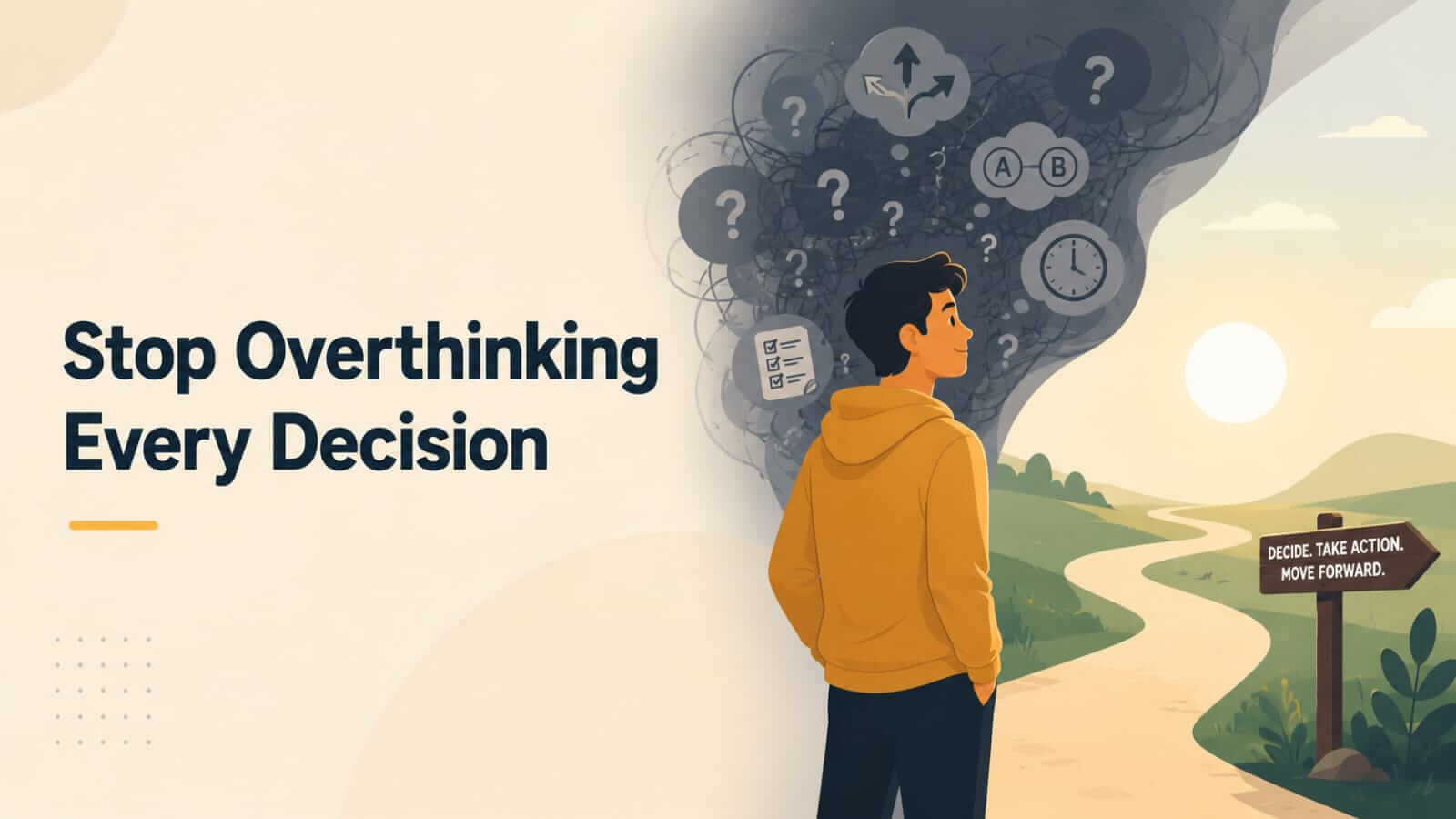
Overthinking usually does not begin with a big problem. It starts with a simple choice. One small decision opens the door to another question, then another doubt, and before long your mind is spinning through every possible outcome. You want to make the right choice, so you keep thinking. But instead of bringing peace, all that thinking creates more pressure.
If this feels familiar, please know that you are not alone. Overthinking is often a sign that you care deeply. You want to avoid mistakes, protect yourself from regret, and make good decisions. That is not a weakness. It is a human response.
The challenge is learning how to think clearly without getting stuck in endless thought.
“Vulnerability sounds like truth and feels like courage.”
Sometimes the courage is not in having all the answers. Sometimes it is in choosing gently, trusting yourself, and moving forward.
The Problem Behind It
Overthinking often comes from fear. Fear of choosing wrong. Fear of being judged. Fear of missing a better option. Fear of consequences. When the mind feels unsafe, it keeps searching for certainty.
But life rarely offers perfect certainty. Most decisions come with some level of unknown. The more you try to remove every bit of risk, the more exhausted and anxious you become. Instead of helping you decide, overthinking keeps you emotionally stuck.
It can also make simple choices feel much bigger than they are. A small decision turns into a test of your intelligence, your future, or your worth. That is when the pressure becomes heavy. And heavy thinking makes it even harder to move.
1. Pause Before You Rush to Decide
When you feel overwhelmed, give yourself a moment to breathe. You do not need to answer every question instantly. A short pause can stop your mind from spiraling.
Take a few slow breaths. Step away for a while. Let your nervous system settle before you try to solve the problem. Calm thinking is always clearer than panicked thinking.
You are allowed to slow down before deciding. In fact, slowing down often helps you see the situation more honestly.
2. Ask What Really Matters
Overthinking grows when every detail feels equally important. It helps to step back and ask, “What is the real decision here?” and “What matters most to me?”
Not every factor deserves the same amount of attention. Some things are essential. Others are just noise. When you identify your core value or priority, the decision becomes easier.
For example, you may be choosing between options that are both good. In that case, the question is not, “Which one is perfect?” The better question is, “Which one fits my current needs, values, and energy?”
Clarity comes from simplicity.
3. Accept That No Choice Is Perfect
Many people overthink because they believe there is one perfect answer waiting to be found. But most of the time, there isn’t.
There are only different options, each with its own strengths and trade-offs. Every choice has some risk. Every path has something you will gain and something you may lose. That is part of being human.
When you accept that perfection is impossible, the pressure begins to soften. You stop asking for certainty that life cannot give. Instead, you choose the best available option and trust yourself to handle what comes next.
4. Limit the Time You Spend Thinking
Thought without limits becomes a loop. You need a gentle boundary.
Give yourself a reasonable amount of time to think, reflect, or compare options. Then decide. A time limit does not mean being careless. It means respecting your energy.
You can tell yourself, “I will think about this for 20 minutes, then I will choose.” Or, “I will sleep on it and decide tomorrow.” Structure helps stop mental wandering and brings your attention back to action.
A decision made with a clear mind is usually better than one delayed by endless doubt.
5. Trust Yourself to Adjust Later
One reason people overthink is because they believe the first decision must be the final one. That belief creates fear. It makes every choice feel permanent.
But many decisions can be adjusted later. You can learn, change direction, and refine your path as you go. Not every choice locks your future. Some simply guide it.
Trusting yourself does not mean you will never make mistakes. It means you believe you can handle them. That belief is powerful. It reduces fear and makes decision-making feel lighter.
“Do the best you can until you know better. Then when you know better, do better.” That is a kinder way to move through life.
Conclusion
Overthinking is often a sign that you care, but care should not turn into self-punishment. You do not need to solve every possibility before you begin. You do not need to be certain about everything. You only need to take one honest step at a time.
Pause when you feel flooded. Focus on what truly matters. Let go of the idea of perfection. Set a limit for your thinking. And trust that you can adjust as you learn.
Peace often comes not from thinking more, but from thinking with more gentleness. The next time your mind starts to spin, remind yourself: you are allowed to choose, learn, and grow along the way.